
How Many Solar Panels Do I Need to Power My Entire Home? (2026 Guide)
By Scott Summers — Visionary Energy Consultant & Lead Researcher at BestGridGen Published: April 24, 2026 | Updated: April 24, 2026 | 12 min read
How Many Solar Panels Do I Need to Power My Entire Home?
The short answer: most U.S. homes need between 17 and 25 solar panels rated at 400 watts each — or roughly a 7 to 10 kilowatt (kW) system. But the precise number for your home depends on three things: how much electricity you actually use, how many peak sun hours your location receives, and how efficient the panels you choose are. This guide walks you through all three, step by step, with real numbers and a formula you can use today.
Table of Contents
- 1. Quick Answer by Home Size
- 2. The Solar Panel Calculation Formula
- 3. Step-by-Step: How to Calculate Your Own Number
- 4. Detailed Solar Panel Requirements by Home Size
- 5. Choosing the Right Solar Panel Type
- 6. Average Peak Sun Hours by U.S. State
- 7. Total Cost of a Home Solar System in 2026
- 8. Do You Need Battery Storage to Power Your Home 24/7?
- 9. Top Solar Panel Recommendations for 2026
- 10. Frequently Asked Questions
- Can solar panels completely eliminate my electricity bill?
- What size solar system do I need for a 2,000 sq ft home?
- How much does a full home solar system cost in 2026?
- Do I need battery storage with my solar system?
- How long do solar panels last?
- What is the fastest way to reduce my electricity bill using solar?
- Final Thoughts
KEY TAKEAWAY
Most U.S. homes need 17–25 solar panels (400W each) to fully eliminate their electricity bill. A 2,000 sq ft house typically needs an 8–10 kW system. Use the formula in Section 2 to calculate your exact number.
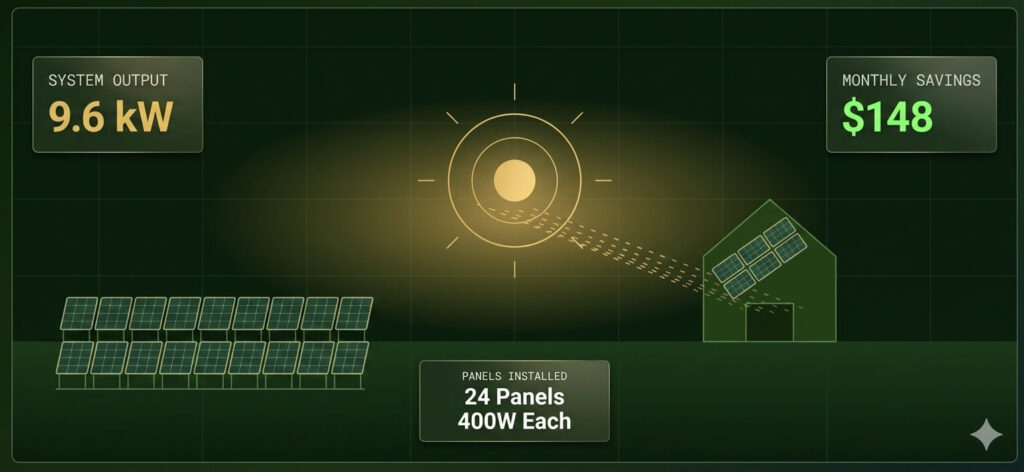
QUICK FORMULA
(Monthly kWh ÷ Monthly peak sun hours) ÷ Panel wattage in kW × 1.25 = Number of panels needed
If you have been asking yourself “how many solar panels do I need to power my entire home,” you are not alone. It is one of the most common questions homeowners ask before going solar — and one that too many installers answer with a vague ballpark rather than a clear, honest calculation.
After fifteen years researching alternative energy systems and consulting on off-grid infrastructure, I can tell you the math is not complicated. You need three numbers and one formula. By the end of this guide, you will know your exact panel count, your total system cost, and how long it will take to pay for itself.
Let’s get into it.

1. Quick Answer by Home Size
If you want a ballpark number before diving into the calculation, use the table below. These estimates assume standard 400W panels and an average of 5 peak sun hours per day — a reasonable median for most of the continental United States.
Small Home — ~1,000 sq ft Estimated monthly usage: ~500 kWh Panels needed: 11 to 14 panels System size: ~4.4 to 5.6 kW
Medium Home — ~2,000 sq ft Estimated monthly usage: ~900 kWh Panels needed: 18 to 23 panels System size: ~7.2 to 9.2 kW
Large Home — ~3,000 sq ft Estimated monthly usage: ~1,300 kWh Panels needed: 25 to 33 panels System size: ~10 to 13 kW
⚠️ Important Warning: Home size is only a rough proxy for energy use. A 2,000 sq ft home with electric heating, an EV charger, and a pool pump can use twice as much electricity as the same-sized home running on gas appliances. Your actual electric bill is the only number that truly matters. Keep reading to use it correctly.
2. The Solar Panel Calculation Formula
Here is the exact formula that solar engineers use to size a residential system. You only need your monthly electric bill and a quick sun hours lookup.
Number of Panels = (Monthly kWh Usage ÷ Monthly Peak Sun Hours) ÷ Panel Wattage in kW × 1.25
Real Example:
- Monthly usage: 900 kWh
- Location: Dallas, Texas (5 peak sun hours/day = 150 monthly hours)
- Panel size: 400W (0.4 kW)
Calculation: (900 ÷ 150) ÷ 0.4 × 1.25 = 18.75 → Round up to 19 panels
Why the 1.25 multiplier?
That 25% buffer accounts for real-world efficiency losses that every solar installation experiences:
- Panel degradation over time (panels lose roughly 0.5% output per year)
- Inverter conversion losses (inverters run at 96–98% efficiency, not 100%)
- Wiring and connection resistance losses
- Minor shading from trees, chimneys, or neighboring structures
- Temperature-related output reduction on extremely hot days
Skipping this buffer is the single most common sizing mistake homeowners make. Systems built without it consistently underperform — especially in the first few hot summers when panels run hotter than their rated conditions.
3. Step-by-Step: How to Calculate Your Own Number
Walk through these five steps using your own home’s data. You will need your most recent electric bill — or ideally, the average of the past 12 months to account for seasonal swings in usage.

Step 1: Find Your Monthly kWh Consumption
Look at your electricity bill for the line that reads “kWh used,” “energy consumed,” or “total usage.” The U.S. average is about 899 kWh per month according to the U.S. Energy Information Administration (EIA), but your actual number may be significantly higher or lower.
If your bill only shows a total dollar amount, divide by your utility’s per-kWh rate to back-calculate: Example: $135 bill ÷ $0.15 per kWh = 900 kWh consumed
Step 2: Look Up Your Location’s Peak Sun Hours
Peak sun hours are not total daylight hours. They measure how many hours per day your location receives sunlight at an intensity of 1,000 watts per square meter — the standard reference condition used to rate solar panels.
Arizona gets about 6 to 7 peak sun hours per day. The Pacific Northwest averages 3.5 to 4. We have a full state-by-state breakdown in Section 6 below.
Step 3: Choose Your Panel Wattage
Modern residential panels in 2025 range from 380W to 440W. The most commonly installed panels fall in the 400 to 420W range. Use 0.4 kW (400W) as your working number if you have not yet chosen a specific brand or model.
Higher-wattage panels cost more per panel but you need fewer of them — a worthwhile trade-off if your roof space is limited.
Step 4: Run the Calculation
Plug your numbers into the formula: (Monthly kWh ÷ Monthly Peak Sun Hours) ÷ Panel kW × 1.25
Monthly peak sun hours = your daily peak sun hours × 30 days
Round your final result up to the nearest whole panel.
Step 5: Verify Your Roof Space
Each standard 400W panel requires approximately 18 to 20 square feet of usable roof area. A 20-panel system needs roughly 360 to 400 square feet of suitable, south-facing (or west-facing) roof.
If your roof does not have enough space, you have two good options: ground-mounted solar arrays, or higher-efficiency panels that produce more power per square foot.
"The number one sizing mistake homeowners make is using their home's square footage instead of their actual electric bill. A 1,500 sq ft home with an EV and an electric heat pump can use three times more power than a 2,500 sq ft home running on gas appliances."
4. Detailed Solar Panel Requirements by Home Size
The table below provides panel counts across different home sizes, monthly consumption levels, and three sun-hour scenarios. All figures use 400W panels and include the 1.25 efficiency buffer.
1,000 sq ft | 500 kWh/month
- Low sun (4 hrs/day): 13 panels
- Avg sun (5 hrs/day): 10 panels
- High sun (6 hrs/day): 9 panels
- Average system size: 4 kW
1,500 sq ft | 700 kWh/month
- Low sun (4 hrs/day): 18 panels
- Avg sun (5 hrs/day): 15 panels
- High sun (6 hrs/day): 12 panels
- Average system size: 6 kW
2,000 sq ft | 900 kWh/month
- Low sun (4 hrs/day): 23 panels
- Avg sun (5 hrs/day): 19 panels
- High sun (6 hrs/day): 16 panels
- Average system size: 7.6 kW
2,500 sq ft | 1,100 kWh/month
- Low sun (4 hrs/day): 29 panels
- Avg sun (5 hrs/day): 23 panels
- High sun (6 hrs/day): 19 panels
- Average system size: 9.2 kW
3,000 sq ft | 1,300 kWh/month
- Low sun (4 hrs/day): 34 panels
- Avg sun (5 hrs/day): 27 panels
- High sun (6 hrs/day): 23 panels
- Average system size: 10.8 kW
3,500+ sq ft | 1,600 kWh/month
- Low sun (4 hrs/day): 42 panels
- Avg sun (5 hrs/day): 33 panels
- High sun (6 hrs/day): 28 panels
- Average system size: 13.2 kW
💡 Pro Tip — High-Load Appliances That Increase Your Panel Count
If your home uses any of the following, add these estimates to your base calculation:
- Electric vehicle (Level 2 home charger): Add 4 to 6 panels (~300 kWh/month)
- Heat pump water heater: Add 2 to 3 panels
- Swimming pool pump running 8 hrs/day: Add 3 to 5 panels
- Central air conditioning in hot climates: Add 2 to 4 panels
- Home office or server equipment: Add 1 to 2 panels
5. Choosing the Right Solar Panel Type
Not all solar panels are equal. The technology you choose affects both how many panels you need and how much roof space they consume. Here is how the main types compare in 2025.
Monocrystalline Panels
- Efficiency: 19 to 24%
- Lifespan: 25 to 30 years
- Cost per watt: $0.70 to $1.00
- Best for: Limited roof space, maximum output
Polycrystalline Panels
- Efficiency: 15 to 18%
- Lifespan: 20 to 25 years
- Cost per watt: $0.50 to $0.70
- Best for: Budget installations with open roof space
Thin-Film (CIGS/CdTe)
- Efficiency: 10 to 13%
- Lifespan: 15 to 20 years
- Cost per watt: $0.40 to $0.60
- Best for: Low-slope or irregular roof shapes
N-Type TOPCon Panels
- Efficiency: 21 to 25%
- Lifespan: 30+ years
- Cost per watt: $0.85 to $1.10
- Best for: Premium long-term performance
HJT (Heterojunction) Panels
- Efficiency: 22 to 24%
- Lifespan: 30+ years
- Cost per watt: $0.95 to $1.20
- Best for: Hot climates and partially shaded roofs
Our Recommendation for 2026: Go with monocrystalline panels in the 400 to 420W range for the best balance of cost and output. N-type TOPCon panels such as the Jinko Tiger Neo or Longi Hi-MO 6 are worth the premium if you are building a system designed to last 30 or more years. For roofs with partial shading or in consistently hot climates, HJT panels like the REC Alpha deliver superior performance due to their lower temperature coefficient.
6. Average Peak Sun Hours by U.S. State
Your location’s sun exposure is the single biggest variable in the sizing equation. A homeowner in Phoenix needs significantly fewer panels than someone in Seattle — even if they use the exact same amount of electricity — because Arizona receives nearly twice the usable solar radiation per day.
Arizona, Nevada, New Mexico
- Peak sun hours per day: 6.0 to 7.5
- Monthly sun hours: 180 to 225
- Solar potential: Excellent
California (Southern)
- Peak sun hours per day: 5.5 to 6.5
- Monthly sun hours: 165 to 195
- Solar potential: Excellent
Texas, Oklahoma, Kansas
- Peak sun hours per day: 5.0 to 6.0
- Monthly sun hours: 150 to 180
- Solar potential: Very Good
Florida, Georgia, Carolinas
- Peak sun hours per day: 5.0 to 5.5
- Monthly sun hours: 150 to 165
- Solar potential: Very Good
Midwest (Illinois, Indiana, Ohio)
- Peak sun hours per day: 4.0 to 4.5
- Monthly sun hours: 120 to 135
- Solar potential: Good
Northeast (New York, Massachusetts, Connecticut)
- Peak sun hours per day: 3.5 to 4.5
- Monthly sun hours: 105 to 135
- Solar potential: Good
Pacific Northwest (Washington, Oregon)
- Peak sun hours per day: 3.0 to 4.0
- Monthly sun hours: 90 to 120
- Solar potential: Moderate
Alaska (Southern)
- Peak sun hours per day: 2.5 to 3.5
- Monthly sun hours: 75 to 105
- Solar potential: Low
🌞 Important Insight — Low-Sun States Still Offer Strong Solar ROI
Do not let lower sun hours discourage you if you live in the Northeast or Pacific Northwest. States like Massachusetts, New York, and Connecticut have some of the highest electricity rates in the country — between $0.20 and $0.28 per kWh. Even with fewer peak sun hours, the high cost of grid power makes solar returns comparable to — and sometimes better than — sunnier states with cheap electricity.
[NEWSLETTER CALLOUT — Insert your email opt-in form here]
Get Our Free Solar Sizing Worksheet (PDF) Enter your email and receive Scott’s complete sizing calculator — every formula in this guide in a printable fill-in-the-blank format, plus a state-by-state sun hours database and 2025 incentive tracker. Free for BestGridGen readers.
7. Total Cost of a Home Solar System in 2026
Understanding how many solar panels you need to power your entire home is only part of the picture. Here is a full cost breakdown by system size, including the impact of the 30% federal Investment Tax Credit (ITC).
5 kW System — 13 panels (400W)
- Gross cost before incentives: $13,500
- After 30% federal tax credit: $9,450
- Estimated annual electricity savings: $1,080
- Estimated payback period: 8.8 years
7 kW System — 18 panels (400W)
- Gross cost before incentives: $18,900
- After 30% federal tax credit: $13,230
- Estimated annual electricity savings: $1,512
- Estimated payback period: 8.7 years
8 kW System — 20 panels (400W)
- Gross cost before incentives: $21,600
- After 30% federal tax credit: $15,120
- Estimated annual electricity savings: $1,728
- Estimated payback period: 8.8 years
10 kW System — 25 panels (400W)
- Gross cost before incentives: $27,000
- After 30% federal tax credit: $18,900
- Estimated annual electricity savings: $2,160
- Estimated payback period: 8.8 years
12 kW System — 30 panels (400W)
- Gross cost before incentives: $32,400
- After 30% federal tax credit: $22,680
- Estimated annual electricity savings: $2,592
- Estimated payback period: 8.7 years
Note: Annual savings estimates based on U.S. average electricity rate of $0.16/kWh. Your actual savings will vary depending on your local utility rate.
About the Federal Solar Tax Credit
The federal Investment Tax Credit (ITC) allows you to deduct 30% of your total system cost — panels, inverter, labor, racking, and wiring — directly from your federal income tax bill. This is not a rebate; it reduces what you owe at tax time.
The credit holds at 30% through 2032, then steps down to 26% in 2033 and 22% in 2034 before expiring unless Congress renews it. Installing sooner captures the full credit.
💰 Pro Tip — Stack Your Incentives
Many states offer additional credits on top of the federal ITC. California, New York, Massachusetts, Florida, and Texas all have notable state-level rebate or net metering programs. Check the Database of State Incentives for Renewables and Efficiency (DSIRE) at dsireusa.org for the most current programs in your state. Stacking state and federal incentives can reduce your net system cost by 35 to 45%.
8. Do You Need Battery Storage to Power Your Home 24/7?
Here is the honest truth that many solar companies gloss over: solar panels alone do not power your home at night. They generate electricity only when the sun is shining. There are two well-tested approaches to handling nighttime and low-sun energy needs.
Option A: Grid-Tied System with Net Metering (No Battery Required)
In this setup, your panels export surplus energy to the grid during peak daylight hours. Your utility company credits you for each kilowatt-hour exported, and you draw against those credits at night. This is the most cost-effective option for homeowners in states with favorable net metering policies.
With a properly sized grid-tied system, you can achieve a near-zero or zero monthly electricity bill without ever buying a battery. The grid essentially acts as your storage system.
Best for: Homeowners in states with strong net metering, no frequent power outages, and a priority on maximum financial return.
Option B: Solar + Battery Storage (True Energy Independence)
If your goal is genuine independence from the grid — or if you live in a state where net metering is being reduced, or if power outages are common in your area — home battery storage is the right move.
A 10 to 15 kWh home battery covers most households’ nighttime energy needs comfortably. Battery costs have dropped significantly since 2020. A quality system now runs between $10,000 and $16,000 installed, before incentives.
Best for: Homeowners seeking true off-grid capability, those in frequent outage areas, or those in states cutting back net metering credits.
Home Battery Comparison — 2026
Tesla Powerwall 3
- Capacity: 13.5 kWh
- Installed cost: $12,000 to $14,500
- Backup duration (avg home): 10 to 14 hours
- Best for: Whole-home grid-tied backup
Enphase IQ Battery 5P
- Capacity: 5 kWh (stackable to 15+ kWh)
- Installed cost: $5,500 to $7,000 per unit
- Backup duration: 4 to 5 hours per unit
- Best for: Modular partial backup, Enphase microinverter systems
Franklin WH Home Battery
- Capacity: 13.6 kWh
- Installed cost: $11,000 to $13,500
- Backup duration: 10 to 13 hours
- Best for: Full home backup, competitive Powerwall alternative
EcoFlow DELTA Pro Ultra
- Capacity: 6 to 60 kWh (modular)
- Installed cost: $5,000 to $25,000+
- Backup duration: Flexible based on configuration
- Best for: Off-grid living, whole-home portable backup
Related post: Best Home Battery Backup Systems of 2025 — Top 7 Picks for Every Budget
9. Top Solar Panel Recommendations for 2026
Based on our ongoing research and performance tracking, here are the three panels we recommend most for full-home installations in 2026. Each has been evaluated for efficiency, durability, warranty terms, and real-world value.
🏅 Editor’s Pick — Best Overall REC Alpha Pure-R 430W
N-type heterojunction (HJT) technology delivers 22.3% efficiency with exceptional low-light and high-temperature performance — making it the ideal choice for northeast homeowners, cloudy climates, or hot summers where panels routinely exceed 25°C.
- Efficiency: 22.3%
- Power output: 430W
- Warranty: 25-year product warranty + 30-year power output guarantee
- Est. cost per panel: $420 to $480 (before installation labor)
- Best for: Maximum long-term performance, low-light climates
Why we recommend it: The REC Alpha consistently outperforms its rated specs in real-world conditions — particularly on overcast days and during summer heat peaks. It is the most future-proof panel in this price range.
🏅 Best Value — Most Installed Jinko Tiger Neo 420W
The world’s best-selling residential solar panel for good reason. N-type TOPCon cells deliver 21.76% efficiency at a price point that makes a 20+ panel system genuinely affordable for middle-income homeowners.
- Efficiency: 21.76%
- Power output: 420W
- Warranty: 25-year product warranty + 30-year performance guarantee
- Annual degradation rate: Less than 0.4% per year
- Est. cost per panel: $280 to $330 (before installation labor)
- Best for: Full-home systems, budget-conscious buyers seeking premium efficiency
Why we recommend it: Jinko’s quality control and global supply chain mean consistent panel performance. The low degradation rate means this panel still delivers strong output 20+ years from installation — making it one of the best dollar-per-watt investments available in 2025.
🏅 Best for Limited Roof Space SunPower Maxeon 7 440W
If your roof size is the limiting factor in your system design, SunPower’s Maxeon 7 line delivers the highest wattage per square foot available in residential solar. At 24.1% efficiency, you need fewer panels to reach your target system size.
- Efficiency: 24.1%
- Power output: 440W
- Warranty: Industry-leading 40-year product and performance warranty
- Est. cost per panel: $520 to $600 (before installation labor)
- Best for: Small or complex roofs, partial shading situations, maximum output per square foot
Why we recommend it: The premium price is justified when roof space genuinely limits your system size. Fewer panels also means fewer roof penetrations, lower labor cost, and simpler wiring. The 40-year warranty is unmatched in the industry.
Affiliate disclosure: Some links in this post may earn BestGridGen a small commission at no extra cost to you. We only recommend products we have researched and would genuinely suggest to our own families.
10. Frequently Asked Questions
How many solar panels do I need to power my entire home?
Most U.S. homes need between 17 and 25 solar panels rated at 400 watts each to fully cover their electricity usage. The exact number depends on your monthly kWh consumption, your location’s peak sun hours, and the wattage of the panels you choose. Use the formula in Section 2 of this guide to calculate your specific number in under five minutes
Can solar panels completely eliminate my electricity bill?
Yes — a correctly sized solar system can bring your electricity bill to zero. With net metering, excess solar energy you generate during the day is exported to the grid and credited against the power you draw at night, effectively giving you 24/7 solar coverage without a battery. Achieving a genuine $0 bill requires accurate sizing based on your real consumption and a utility that offers favorable net metering rates.
What size solar system do I need for a 2,000 sq ft home?
A 2,000 sq ft home typically uses between 800 and 1,100 kWh per month depending on your climate, heating type, and appliances. To fully power it, you would need approximately a 7 to 9 kW solar system — roughly 18 to 23 panels at 400 watts each, assuming 5 peak sun hours per day with a 25% efficiency buffer applied.
How much does a full home solar system cost in 2026?
A complete residential solar installation typically costs between $15,000 and $30,000 before incentives, depending on system size and your location. After applying the 30% federal solar Investment Tax Credit (ITC), the effective cost drops to $10,500 to $21,000. Most homeowners recover their full investment within 6 to 9 years through electricity savings. After payback, every kilowatt-hour your panels generate is essentially free.
Do I need battery storage with my solar system?
Not necessarily. If your utility offers favorable net metering, a grid-tied system without a battery is typically the most cost-effective setup — you get effective 24/7 solar coverage through grid energy credits. Home battery storage makes sense if you want true off-grid independence, live in an area with frequent outages, or live in a state where net metering policies are being scaled back.
How long do solar panels last?
Modern monocrystalline solar panels are built to last 25 to 30 years, with most manufacturers guaranteeing at least 80 to 87% of original output at the 25-year mark. Premium panels like SunPower Maxeon carry a 40-year warranty. Solar panels do not fail suddenly — they degrade very slowly over time, meaning a 20-year-old system still produces usable power, just somewhat less than it did on day one.
What is the fastest way to reduce my electricity bill using solar?
The fastest impact comes from combining solar panels with a few simple energy-efficiency upgrades: switching to LED lighting, installing a smart thermostat, upgrading to a heat pump water heater, and sealing air leaks. Homeowners who pair solar with basic efficiency improvements typically see their electricity bills drop by 80 to 100% within the first year of installation.
Final Thoughts
Figuring out how many solar panels you need to power your entire home comes down to one simple principle: start with your real consumption data, not your home’s square footage.
Pull out your electric bill, find your monthly kWh number, look up your local peak sun hours, and run the formula. In most cases, you will land somewhere between 15 and 25 panels — a system that pays for itself in under a decade and generates clean, free electricity for 25 to 30 years after that.
At BestGridGen, we believe that affordable, reliable power is a right — not a luxury. The technology to achieve it is available, the incentives have never been better, and the math has never been more favorable.
If you found this guide helpful, share it with someone who is thinking about going solar. And if you have questions about your specific situation, drop them in the comments below — I read every one.
— Scott Summers Lead Researcher, BestGridGen
Sources and further reading: — U.S. Energy Information Administration (EIA): Average U.S. residential electricity consumption data — National Renewable Energy Laboratory (NREL): PVWatts solar irradiance data by state — Database of State Incentives for Renewables & Efficiency (DSIRE): dsireusa.org — U.S. Department of Energy: Homeowner’s Guide to the Federal Tax Credit for Solar Photovoltaics
This video shows how YOU, your family, your friends …and basically anyone can easily create their own (free) energy at home!